


Επιστροφή


Επιστροφή
Olecranon bursitis is caused by inflammation of the serous bursa of the elbow joint. It is distinguished into acute and chronic forms, which, however, have a similar progression.
Olecranon bursitis is the inflammation of the olecranon bursa, a small fluid-filled sac located over the bony tip of the elbow (olecranon). The bursa acts as a cushion to reduce friction between the skin and the bone.
A common cause of chronic elbow bursitis is the repeated strain on the elbow’s serous bursa due to activities like leaning or resting on hard surgaces. This constant pressure and irritation can lead to inflammation of the bursa, commonly observed in students and office workers who rest their elbows on desks.
Acute elbow (olecranon) bursitis is inflammation of the bursa at the tip of the elbow, often triggered by trauma like a direct blow or repetitive pressure. Athletes involved in contact sports often experience this due to impacts or lacerations to the elbow.
Other causes of elbow (olecranon) bursitis may include gout, rheumatoid arthritis, as well as other autoimmune diseases.
Although less common, infection by bacteria or other microorganisms can lead to septic bursitis. This can occur if there is a break in the skin over the elbow, allowing bacteria to enter the bursa.
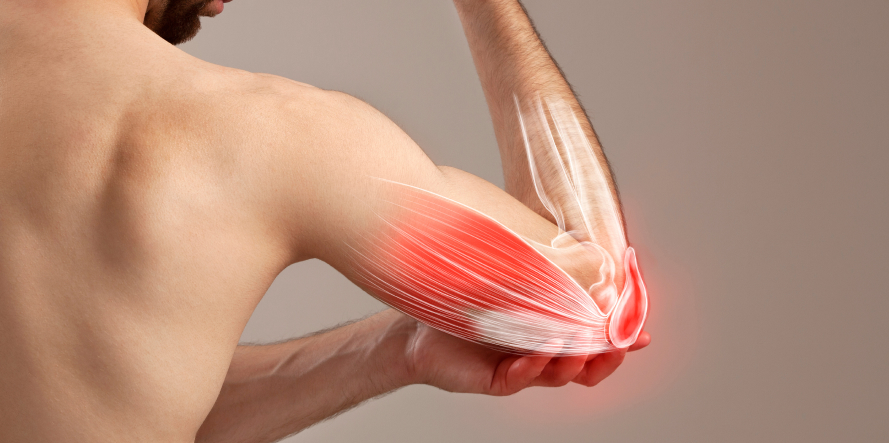
The main symptom of olecranon bursitis is noticeable swelling at the back (posterior surface) of the elbow. The swelling often looks like an egg-shaped lump. The area may be red, warm to the touch and painful, indicating active inflammation.
In the acute elbow bursitis, the symptoms develop quickly, with rapid swelling and significant pain. In chronic elbow (olecranon) bursitis the swelling develops slowly over time and may cause little to no pain.
Diagnosis is mainly based on the clinical presentation (visible swelling and typical symptoms), as it is quite characteristic. It is essential to assess the elbow’s range of motion to rule out joint involvement or movement restrictions.
Diagnosis can be confirmed with an ultrasound of the elbow. Magnetic resonance imaging (MRI) is rarely required but can provide detailed images if other conditions are suspected.
Differential diagnosis includes rheumatic diseases, lipoma or liposarcoma of the area.
The treatment of elbow (olecranon) bursitis is generally conservative (non-surgical). The patient should always follow the doctor’s instructions:
Surgery is indicated for cases where conservative management fails, or if there is a significant infection that does not respond to medication.
During the surgical procedure, the surgeon removes the inflamed bursa through a small incision. If infection is present, the area is thoroughly cleaned (debridement) to remove infected tissue.
After surgery, the elbow is immobilized for 3-5 days to allow healing. Gradual mobilization (gentle movement) begins after this period. Stitches are usually removed after about 1-2 weeks. Most patients recover well, with smooth postoperative courses and very low rates of bursitis returning.

Fill in your details below and we will contact you immediately!
WIN THE
MATCH POINT IN THE RACE
OF YOUR HEALTH!