


Επιστροφή


Επιστροφή
Golfer’s Elbow, medically known as medial epicondylitis, is a type of tendinopathy (tendon disorder) that causes pain and inflammation on the inner side of the elbow, where the forearm tendons attach to the medial epicondyle of the humerus (upper arm bone). The pain might spread into the forearm and wrist. It is a condition is similar to “tennis elbow”, which occurs on the outside of the elbow. It’s not limited to golfers. Tennis players and others who repeatedly use their wrists or clench their fingers also can develop golfer’s elbow.
The pain of golfer’s elbow doesn’t have to keep you off the course or away from your favorite activities. The appropriate treatment and rest can get you back into the swing of things.
Golfer’s elbow is characterized by:
Pain may start gradually and worsen with continued activity.
This can lead to paresthesia (tingling or numbness) in the ring and little fingers—areas supplied by the ulnar nerve.
This symptom overlaps with cubital tunnel syndrome, so proper evaluation is needed.
Medial epicondylitis, commonly called golfer’s elbow, is a condition characterized by pain and inflammation on the inner side of the elbow (medial side), where the flexor tendons of the forearm attach to the bony prominence (medial epicondyle) of the humerus. The condition stems from overuse or repetitive strain on the tendons that flex the wrist and fingers, especially under force or poor biomechanics. There are two main contributors:
The forceful wrist/finger movements (especially bending or gripping), the poor technique in sports or lifting, the inadequate warm-up or conditioning and the unbalanced muscle strength or poor posture may contribute to the onset of the condition.
Apart from golf, several other sports and occupations can lead to golfer’s elbow (medial epicondylitis), such as:
Tennis: Poor technique, especially during backhand strokes and the use of an unsuitable racket can injure the tendon.
Throwing sports: Activities like javelin, archery and baseball can also cause golfer’s elbow.
Bodybuilding: Incorrect wrist positioning (e.g., flexed wrist during curls) and lifting heavy weights without stabilization or support may contribute to injury.
Repetitive forceful movements: Occupations such as construction workers, plumbers, and carpenters are at higher risk of developing golfer’s elbow.
Note: Risk increases with frequent activity (over 1 hour per day, several days per week).
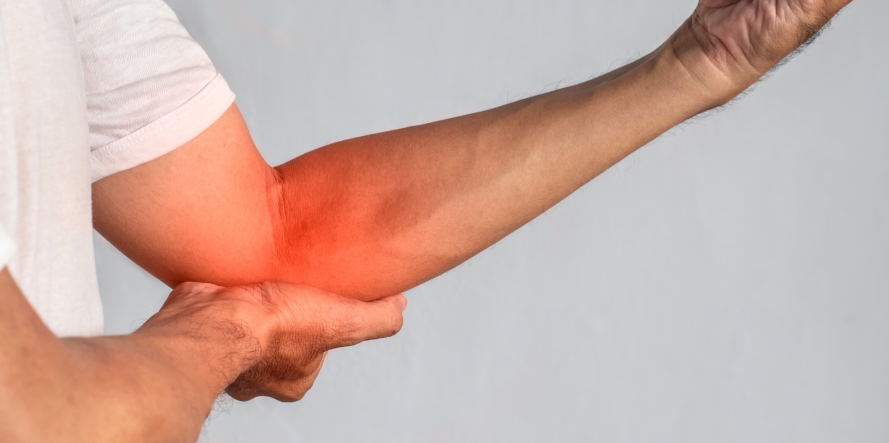
Golfer’s elbow is usually diagnosed based on a detailed medical history and a clinical examination by an experienced orthopedic specialist. To evaluate pain and stiffness, the doctor might apply pressure to the affected area or ask you to move your elbow, wrist and fingers in various ways.
In special cases, an X-ray can help the doctor rule out other causes of elbow pain, such as elbow arthritis, bone spurs, fractures or calcific deposits in chronic cases. Rarely, in persistent or severe cases or if another diagnosis is suspected, more comprehensive imaging tests — such as MRI — are performed.
The first and most important treatment is to rest the arm. Stop doing the motion that caused the injury. If tolerated, NSAIDs (nonsteroidal anti-inflammatory drugs) pain medications can be tried for a brief period initially, but this does not cure the condition and should not be used long term. If pain continues for several weeks despite rest and a short course of pain relievers, consult an orthopedist specializing in upper extremity conditions. For more severe cases, or cases that are not responding to the above-mentioned treatment methods, may benefit from an injection of cortisone or platelet-rich plasma (PRP) into the area.
Cortisone is a corticosteroid that helps reduce inflammation. Though it may help the symptoms, cortisone provides only a short-term benefit. In addition, a concern regarding cortisone use is that it can potentially weaken muscle and tendon tissue.
However, the injection of Platelet-Rich Plasma (PRP), which involves isolating the growth factors from one’s own blood and injecting them into the tendon, is thought to be less damaging to the tendon than cortisone and has been shown to benefit some patients.
The next most important part of treatment for golfer’s elbow (medial epicondylitis) is a physical therapy or exercise program to strengthen and rehabilitate the tendon. However, this can take weeks to months to see improvement.
Surgical Treatment
Surgery is considered only when conservative measures fail, typically after 9 to 12 months of persistent symptoms. This is rare and reserved for chronic, debilitating cases. The surgical treatment for the golfer’s elbow is a minimally invasive procedure that is performed through a small incision that is made over the inner elbow. The main goal is the removal of degenerated tendon tissue (tenotomy) to relieve pain and restore function. Surgery usually has good success rates, but recovery can take several weeks to months, followed by rehabilitation.
Recovery and Prognosis

Fill in your details below and we will contact you immediately!
WIN THE
MATCH POINT IN THE RACE
OF YOUR HEALTH!