


Επιστροφή


Επιστροφή
When the joint surfaces of the elbow’s three bones are separated, the elbow is dislocated. Elbow dislocation can be complete or partial, and usually occur after a trauma, such as a fall, motor vehicle collision, or other accident. It is the second most common large joint dislocation and accounts for 10-25% of all elbow injuries in the adult population. It is also the most common dislocation in children.
Elbow dislocation, a common injury, often results from falls onto an outstretched hand. While the elbow is typically in extension or flexion during the fall, the resulting dislocation is usually posterior. Fracture of the surrounding bones is also a frequent occurrence alongside the dislocation.
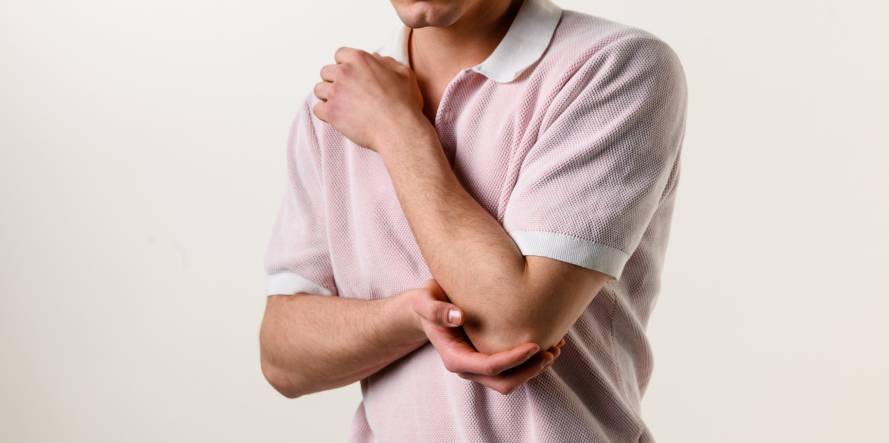
The diagnosis is relatively simple and elbow dislocation is often quite obvious visually. Normally, when the elbow is extended, you can see a distinct triangular shape formed by three bones: olecranon, medial epicondyle and lateral epicondyle. When the elbow is dislocated, this triangle disappears or becomes distorted because the bones are no longer aligned properly.
An X-ray is essential for confirming the diagnosis. It shows the exact position and direction of the dislocation (usually posterior, but can be anterior or lateral). It also helps detect any associated fractures, which are common with dislocations due to the forces involved.
The primary treatment goal is to reduce (put back in place) the dislocated elbow joint as soon as possible. This needs to be done after checking the neurovascular status—meaning, doctors ensure that blood flow and nerve function to the arm and hand are intact, because the dislocation can compress or damage blood vessels and nerves. Most elbow dislocations can be treated with a closed reduction, which means no surgery—just manually manipulating the joint back into place, typically done under pain relief or sedation. After the elbow is put back, the joint may be unstable due to soft tissue (ligament, tendon) injury. The arm is often immobilized for 2 to 3 weeks using methods such as simple suspension (e.g., sling). This rest period allows healing but is kept short to avoid stiffness. After immobilization, a structured physiotherapy program begins to restore elbow movement, strength, and function. Early mobilization is important to prevent long-term stiffness and disability.
If significant elbow instability persists, surgical repair of the injured ligaments may be necessary. Surgery is generally performed in cases where there is significant joint instability after reduction, or when ligaments are severely damaged. Surgery aims to repair or reconstruct the injured ligaments to restore stability.

Fill in your details below and we will contact you immediately!
WIN THE
MATCH POINT IN THE RACE
OF YOUR HEALTH!